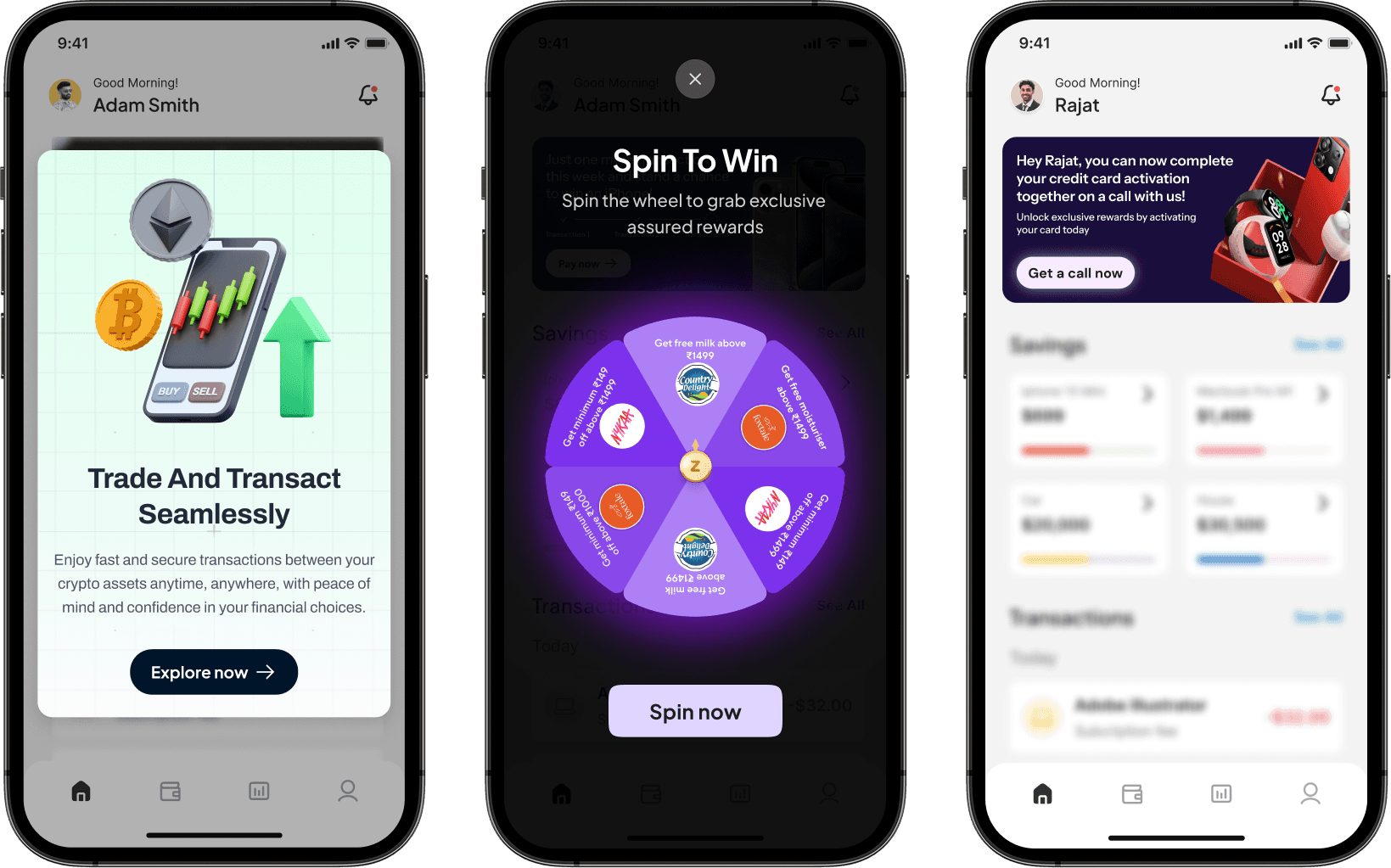
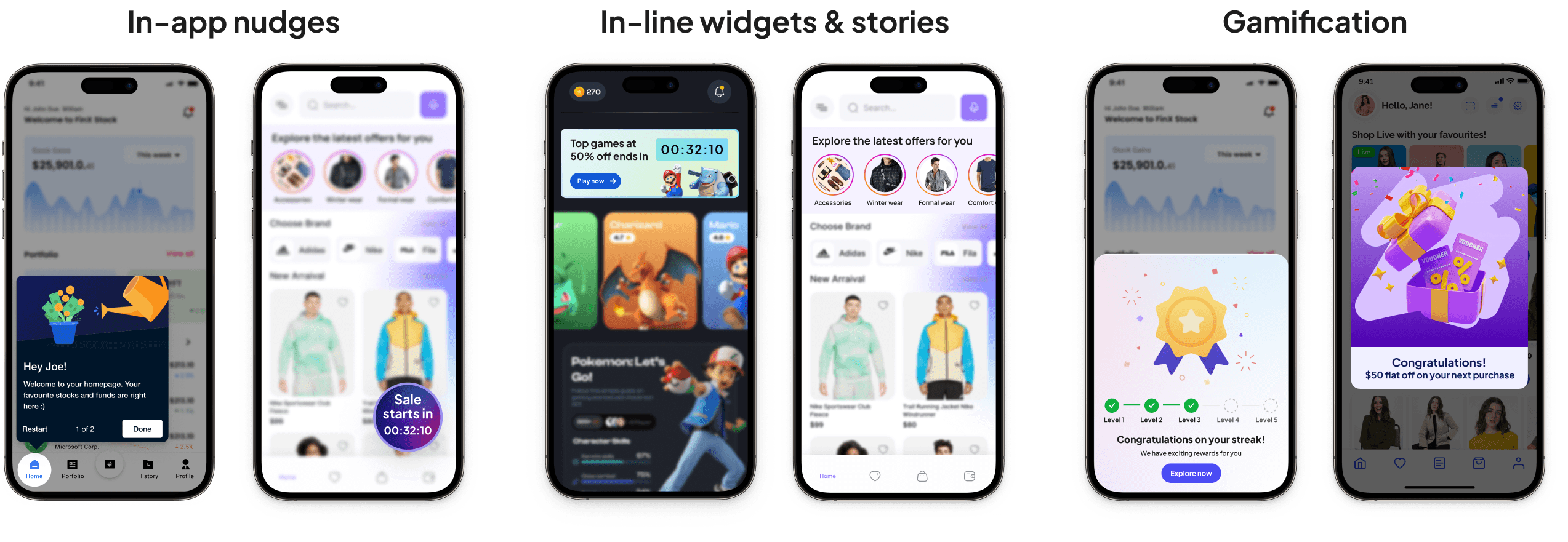
Plotline's current tools allowed teams to create in-app experiences like these


PRE-CURSOR // THE FIRST ROUND OF AI ASSISTS WE DESIGNED IN 2024
I started where everyone was starting in 2024. The campaign creation flow had a lot of fields - audience rules, channel selection, creative configuration, copy, scheduling, goals. I went through each step and asked where AI could cut time.
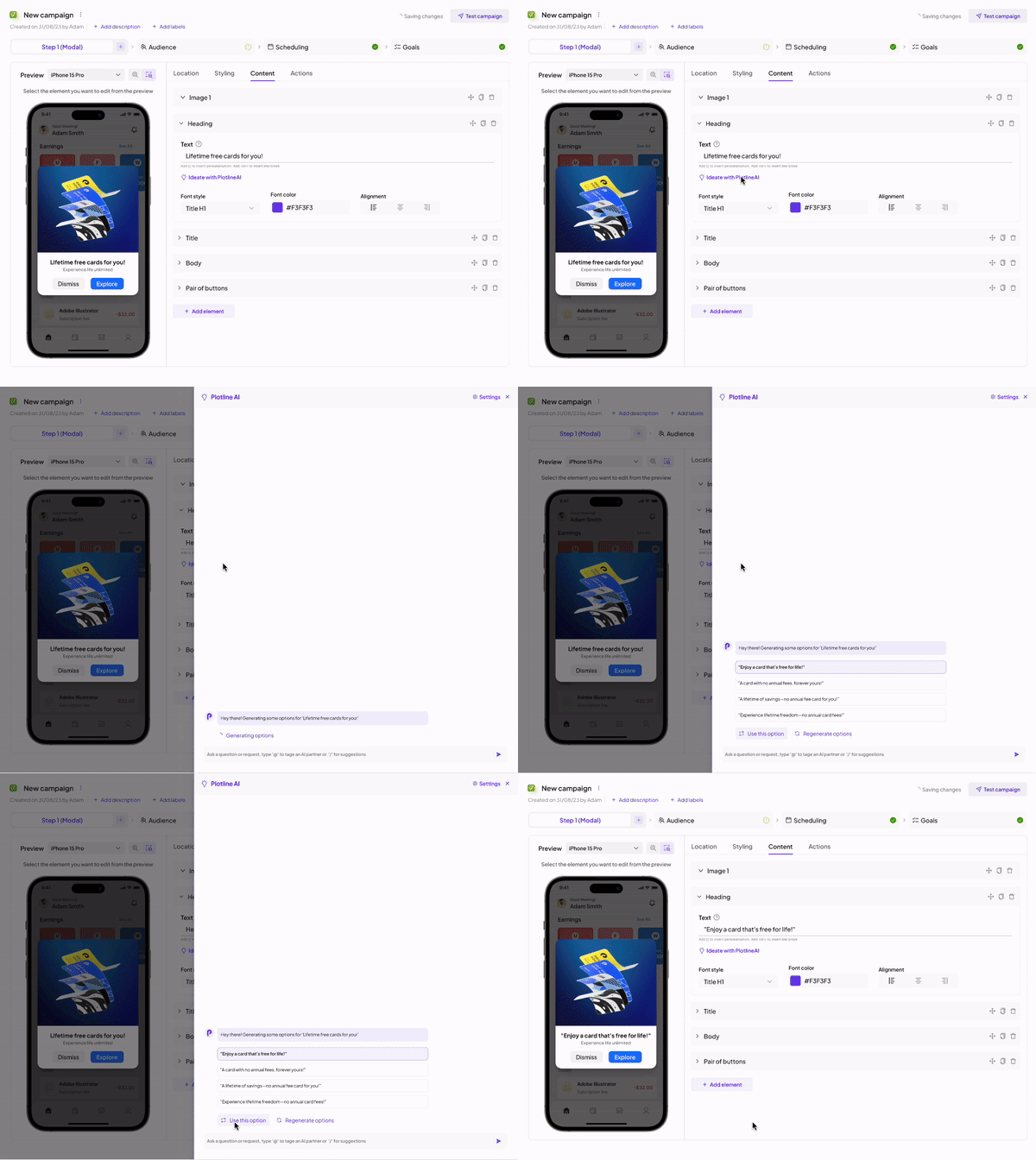
AI Assist 1: Copy suggestions
Every text input got an "Ideate with Plotline AI" option. Click it, get three options tuned to your audience and goal, pick one or riff on it. I used the word "Ideate" instead of "Generate" on purpose - small thing, but "generate" makes it sound like the machine is doing your job, "ideate" keeps it collaborative. That instinct turned out to matter a lot more in the next phase.
AI Assist 2: Brand traits
This came directly from research. I talked to about twenty growth teams across gaming, fintech, and e-commerce - Jar, Niyo, Khatabook, others. The pattern I kept hearing wasn't "AI is too slow" or "AI isn't good enough." It was "AI will make us sound like everybody else." The growth team at Niyo was particularly blunt about it - they're a young fintech brand and that identity shows up in every message they send. They weren't comfortable handing that over to a model.
"We want to be very conscious of how we are using AI to generate campaigns because we don't want to lose our brand identity and uniqueness "
Growth team, Kredivo (Indonesia's top 5 finance company)
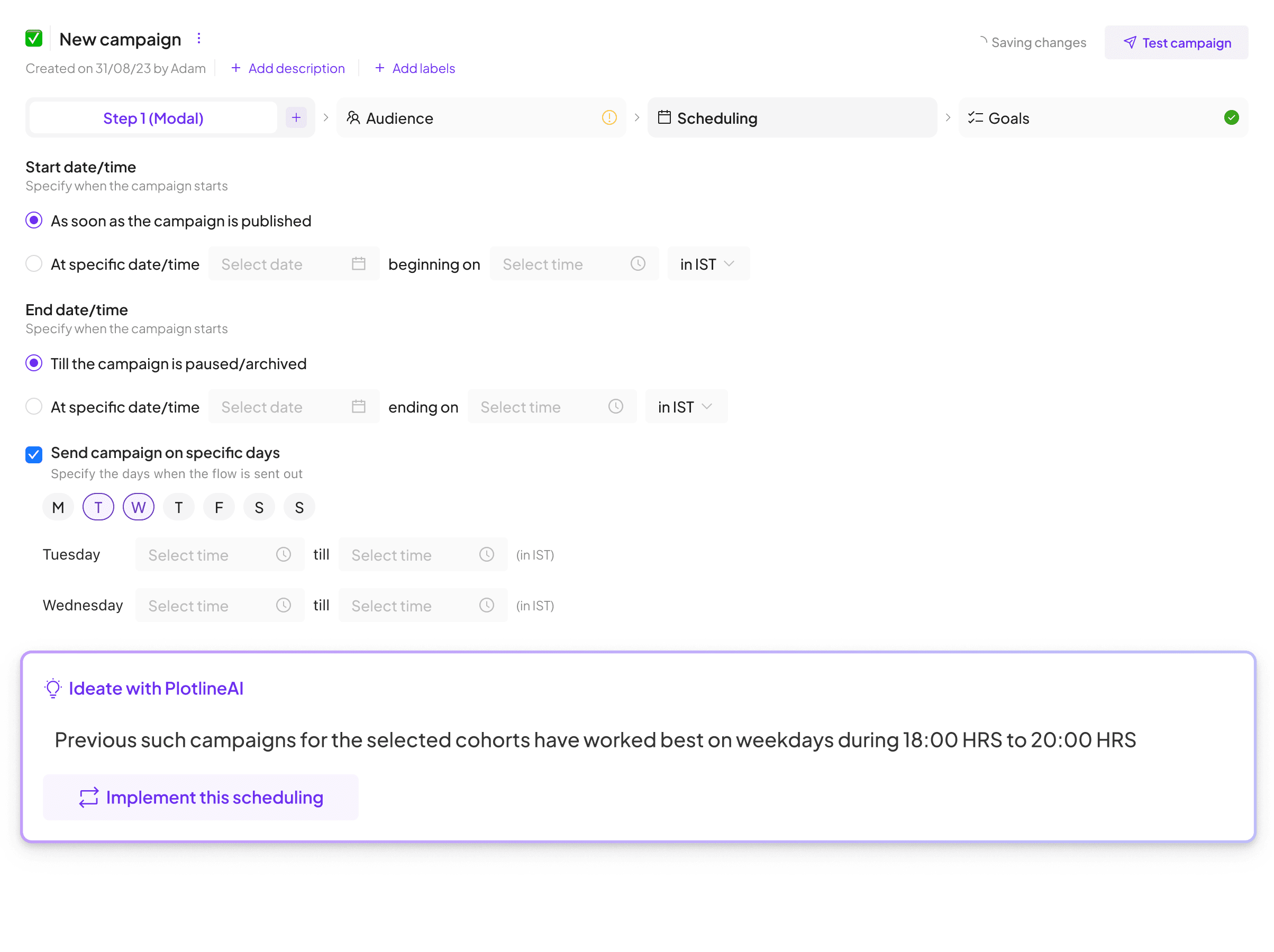
AI Assist 3: Audience & scheduling assist
Timing matters a lot in lifecycle marketing - nudge someone at the wrong moment and you've burned a touch for nothing. I built recommendations based on the audience's behavioral patterns and goal criteria. Not just "send at 10am" but specific windows backed by actual usage data
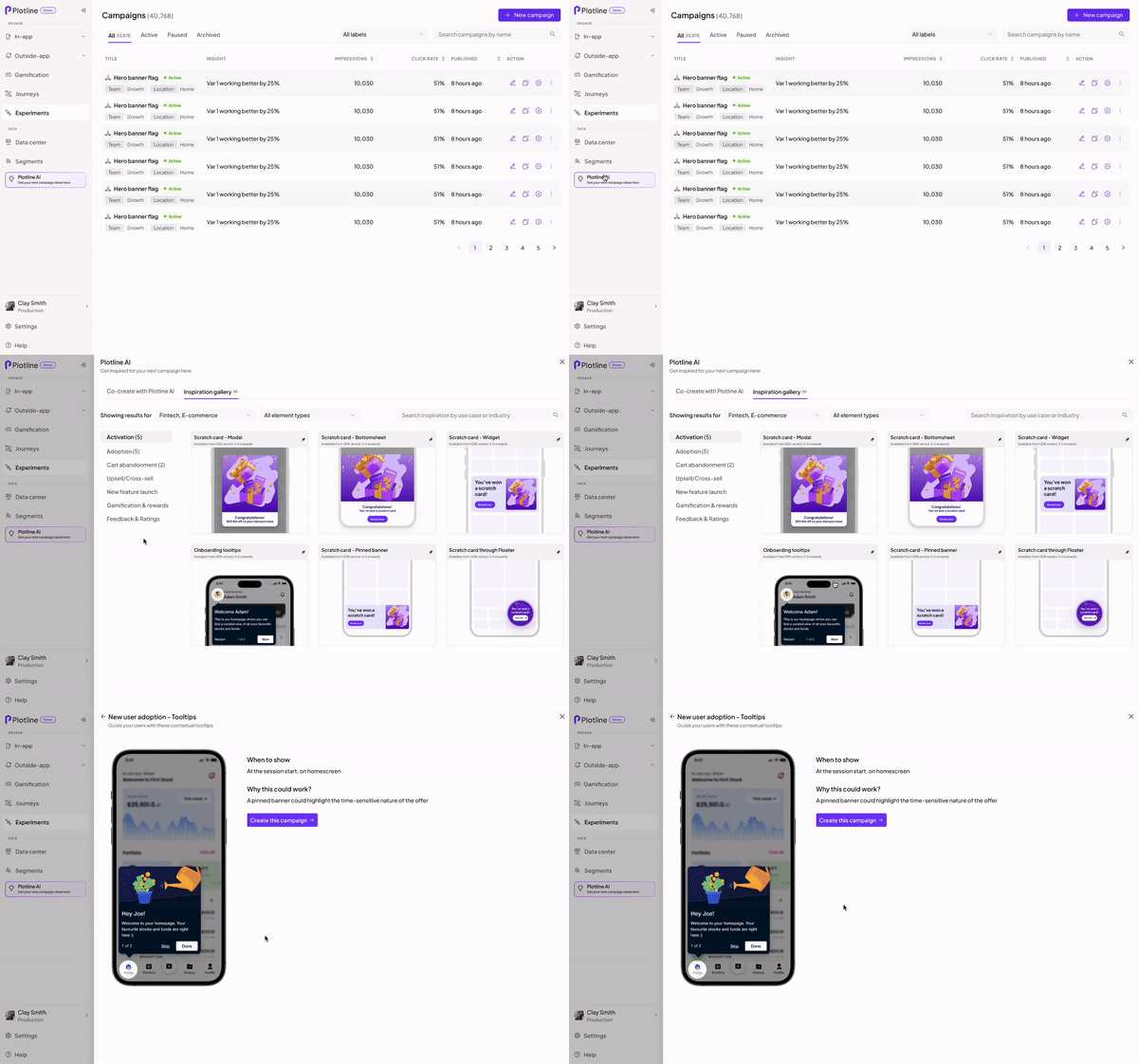
AI Assist 4: Recipes
An inspiration gallery for marketers who knew their goal and audience but were blank on what to actually build. Campaign templates cross-referenced by industry and use case, most of the configuration pre-filled, one click to launch.
Plotline's current tools allowed teams to create in-app experiences like these
These features shipped, they got used, they did what they were supposed to do. But here's the thing, and this took me a few months to fully register: a marketer using Plotline after V1 still opened the same campaign builder, still navigated the same screens, still filled in essentially the same fields. The workflow was identical. I'd put better tools inside an unchanged process. Thus, this was just an incremental update and didn't fully capture the changing mental models of marketers.
REALISATION // WHY THIS WASN'T ENOUGH AND FINDING THE REAL PROBLEM

The real bottleneck was before the builder.
Marketers think in goals, not campaigns.
Alignment was the hidden time sink.
Their ideal experience
They notice something.
A metric drops, a seasonal moment approaches, a cohort starts behaving differently.
Then they form a rough hypothesis
"We should probably re-engage these users" or "This problem looks like it'd respond to an education-led approach."
Then they evaluate whether it's worth the effort
Can I get buy-in? what's the opportunity cost? Then, finally, they build.
Plotline's current tools allowed teams to create in-app experiences like these
“Over the past 2 years, we have seen that the time taken to resolve support tickets is inversely proportional to lifetime value of our customers"

The pattern was consistent across every fintech customer we talked to. The gap wasn't information - the information existed somewhere, in a policy doc, or in an FAQ buried three taps deep. The gap was timing and context. The right information, but not available at the moment the user needed it, in the place they were looking for it
STARTING OVER // ONCE I SAW IT THIS WAY, I COULDN'T UNSEE IT
Before designing anything, I needed to understand what "answering user questions in real-time" actually meant to the people who'd be responsible for it - product and growth teams at our customer companies.
Where do drop-offs actually happen, and which of those moments could a conversation genuinely help?
What would make a marketer trust an AI agent enough to deploy it to their users?
What do end users expect from an AI inside a financial app - and where does trust break down?
What does "good" look like for a conversational interaction in a high-stakes context (lending, investments)?
We ran 1:1 semi-structured interviews with product and growth leads at fintech apps in our customer base. Semi-structured because we wanted to follow threads, we had a guide, but the most valuable findings came from places we didn't expect. We talked to teams at Kredivo, Dream11, and several others across lending, investing, and wallets.
We also did a journey audit, mapped the core user flows (loan application, investment, wallet top-up/withdrawal) against where support tickets were being raised. This gave us a quantitative layer to ground the qualitative interviews.
One deliberate gap: no end-user research upfront. The timeline didn't allow it. We'd validate with real users during the pilot. That was a tradeoff we named out loud
What are the main customer interactions within your app that could benefit from AI-powered conversations (e.g., customer support, product recommendations, order tracking)?
How do you currently gather customer feedback, troubleshoot issues, and upsell products? Would a conversational agent be suitable for any of these?
How do you estimate the agent's impact in your app? (e.g., multilingual support, personalization, deep product knowledge)?
How important is AI-human handover in complex cases? What is your expectation of bot vs. human interactions?
What are your top concerns about integrating conversational AI agents? (Options: technical complexity, security and privacy, customer trust, handling edge cases, impact on brand, regulatory compliance)
“Over the past 2 years, we have seen that the time taken to resolve support tickets is inversely proportional to lifetime value of our customers"
“An agentic experience inside my app should aid the overall discoverabilty and usage. It should intelligently understand when it is needed and what it should help with”

We expected the dominant concern to be "Will the AI give wrong answers?" That was a concern, but it wasn't the primary one.
Marketers were anxious about knowledge gaps - stale information, missing context, wrong answers. But what surprised us was how they wanted to solve this. They wanted to teach the system from conversations they'd already had.
This insight directly shaped the evaluation through a benchmark system.
There was near-universal anxiety about deploying something they couldn't fully preview. Teams wanted to simulate conversations - not just check settings. This wasn't about technical QA. It was about confidence. A marketer needs to be able to say "I have talked to this thing and it makes sense" before they trust it with their users.
The question of escalation - when does the bot hand off to a human, and how - came up in every single interview. More importantly, several people raised brand risk: "If my AI agent says something incorrect about a loan product, I'm liable." This wasn't paranoia. It was valid. It changed how we thought about the autonomy spectrum.
APPROACH // WHAT A SOLUTION WOULD NEED TO DO
Coming out of research, the shape of the solution was getting clearer. Whatever we built needed to solve for these.
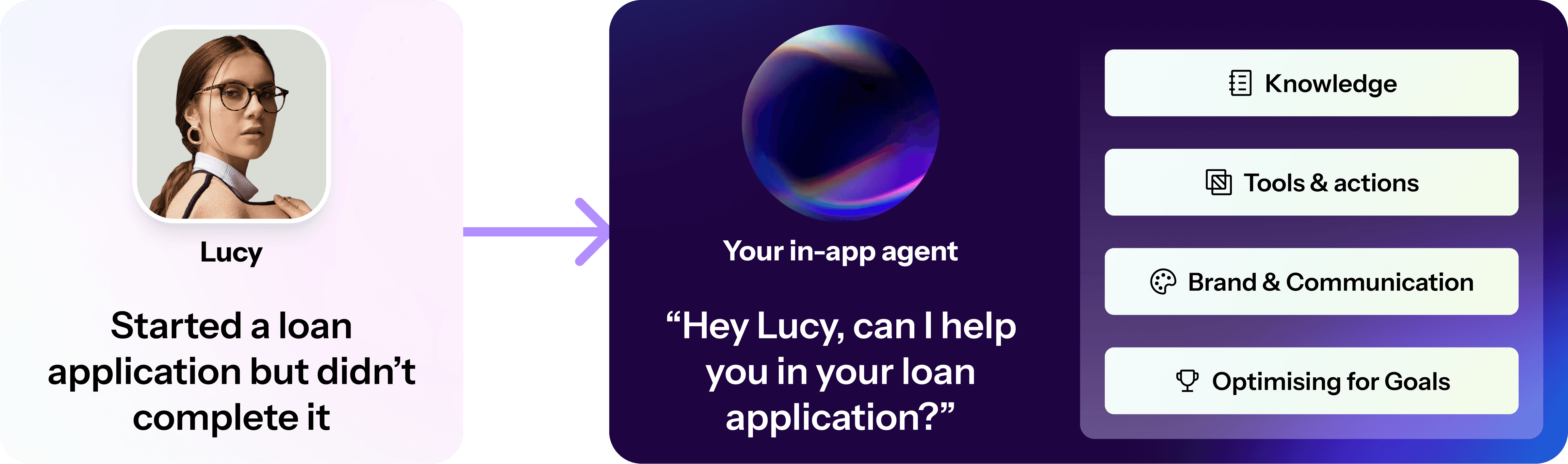
Know where the user is in the app, not just "on the home screen" but "midway through a loan application, on the documentation step."
Know what they're trying to do and tailor the response to that specific intent, not a generic FAQ answer.
Handle questions it hasn't been specifically programmed for the organic, contextual, long-tail questions that no scripted system can anticipate.
Respond in real-time because a 1–2 hour support ticket is a risky approach as it may lead to user abandonment.
Know when to stop because when a question touches compliance, liability, or something it genuinely doesn't know, it needs to hand off or escalate.
TRAINING YOUR AGENT
Knowledge base
Benchmark conversations
Knowledge base
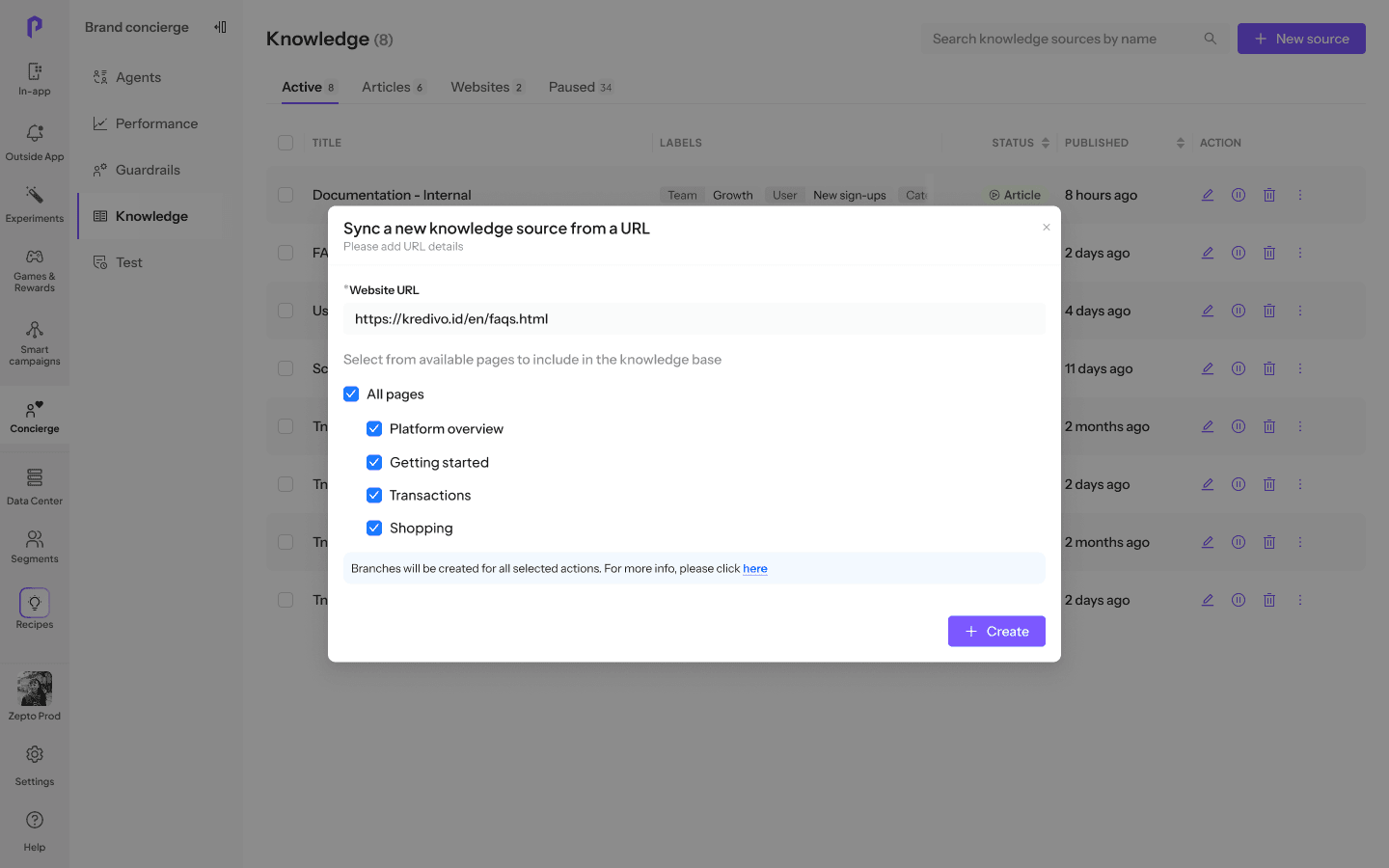
Specific addition of URL based content for only relevant information
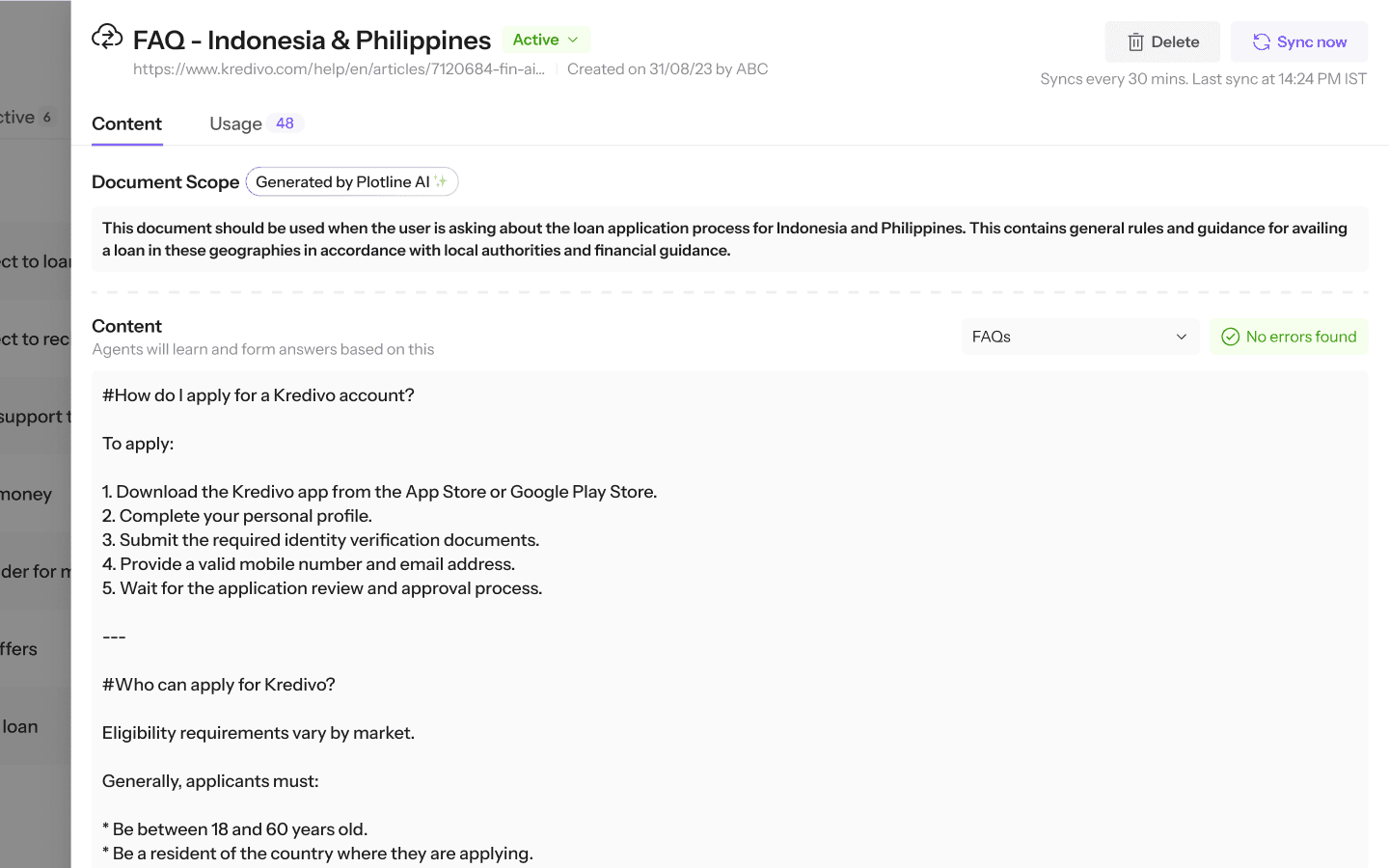
Adding usage context with your knowledge documents
Benchmark conversations
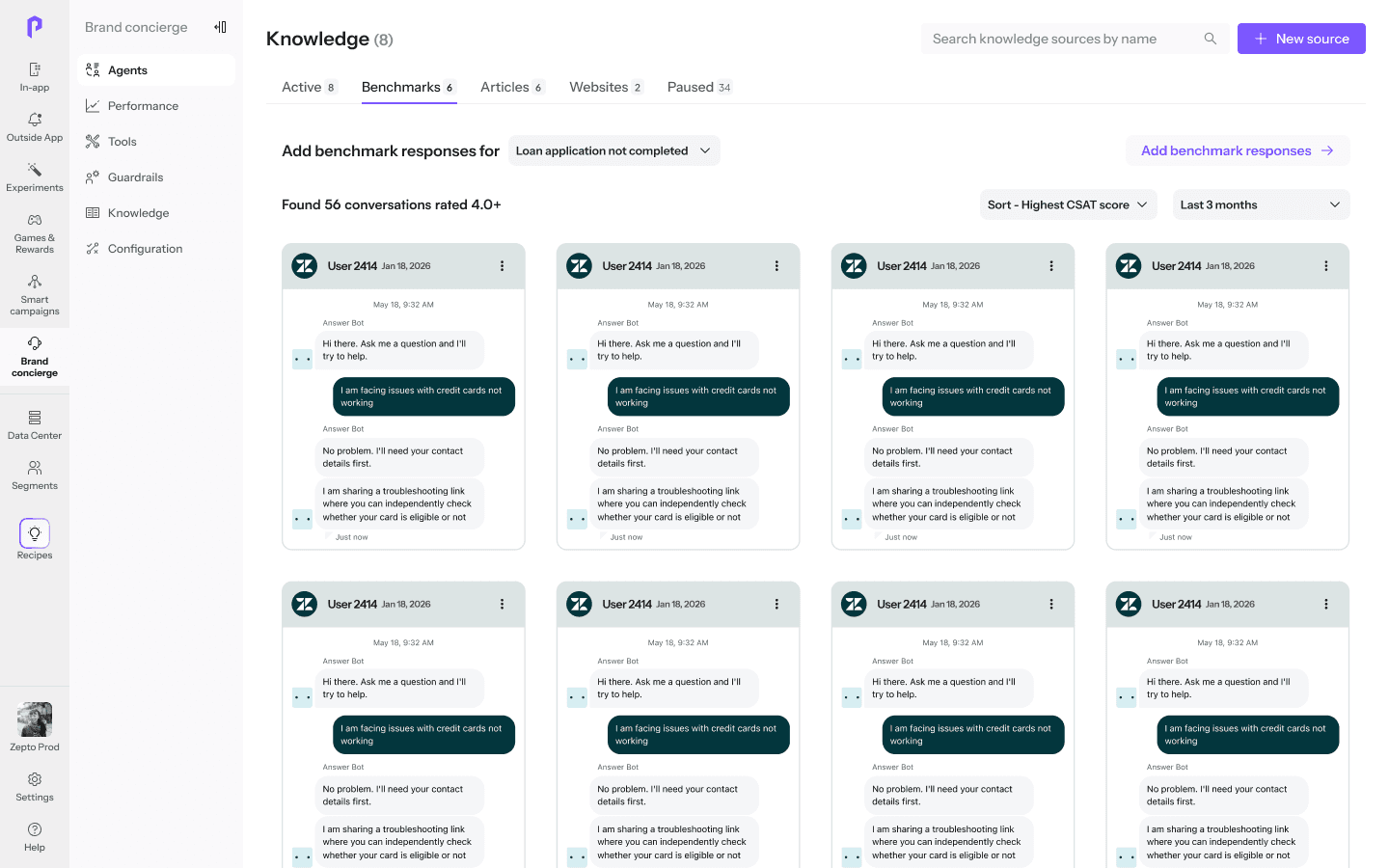
Benchmark addition for human-like responses in your authentic brand voice
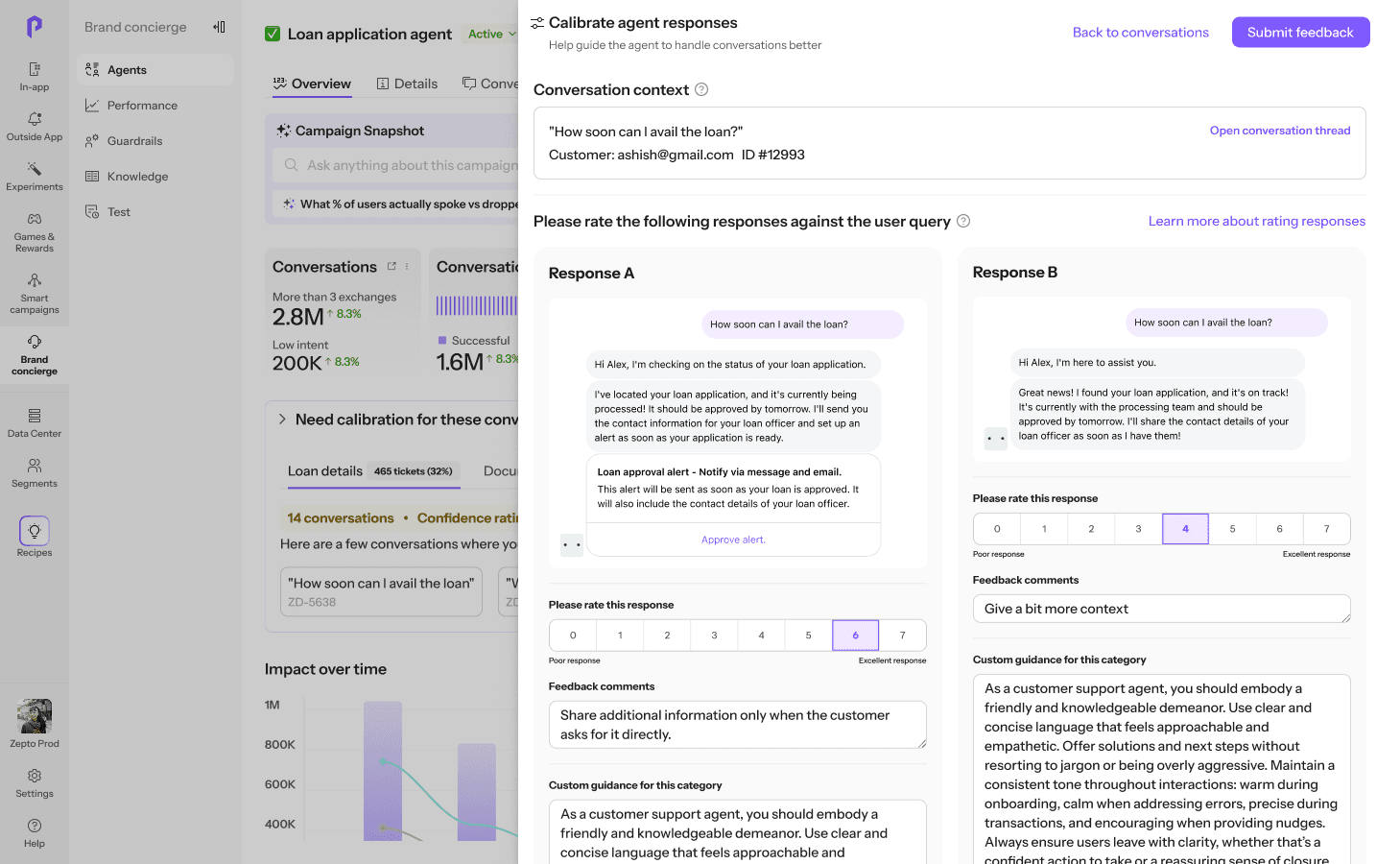
Blind rating system for actual agent responses
CONFIGURING YOUR AGENT

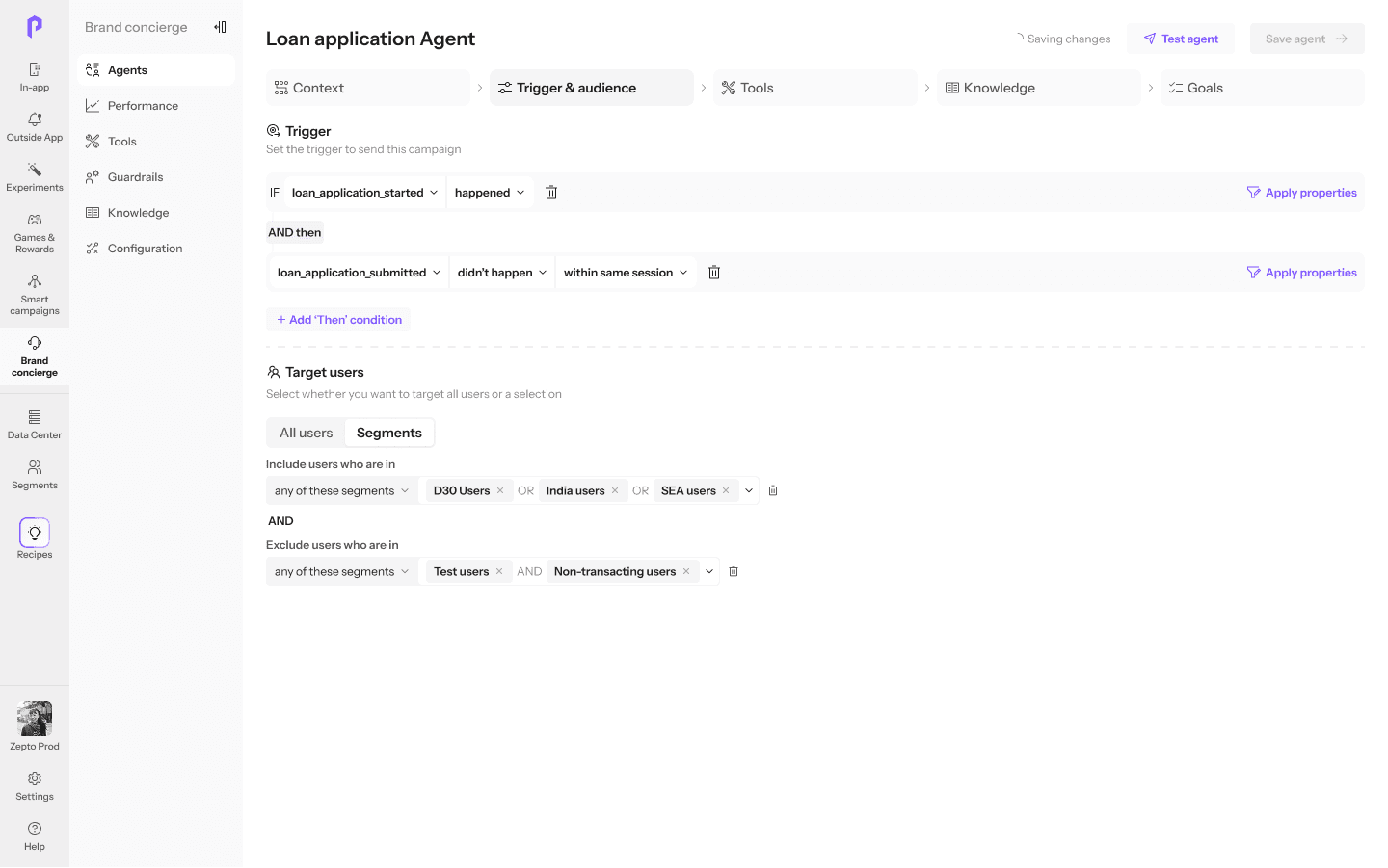
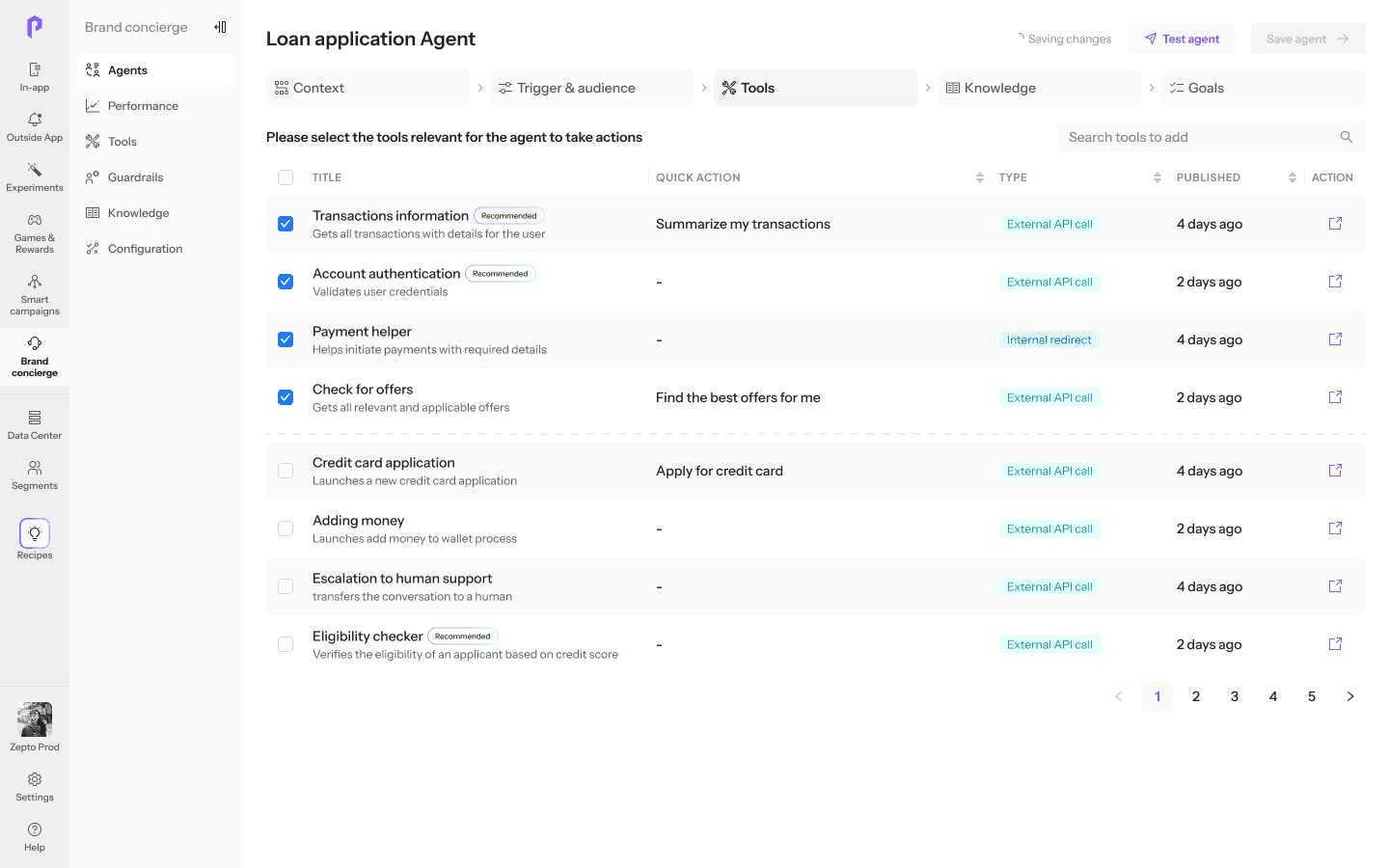
Pre-configured agent templates as the starting block. These can be contextual to any industry the dashboard is configured for

Broken down context for a clear set of instructions to the system
Currently ~ 57%
Currently ~ 45%
Currently ~ 8 minutes
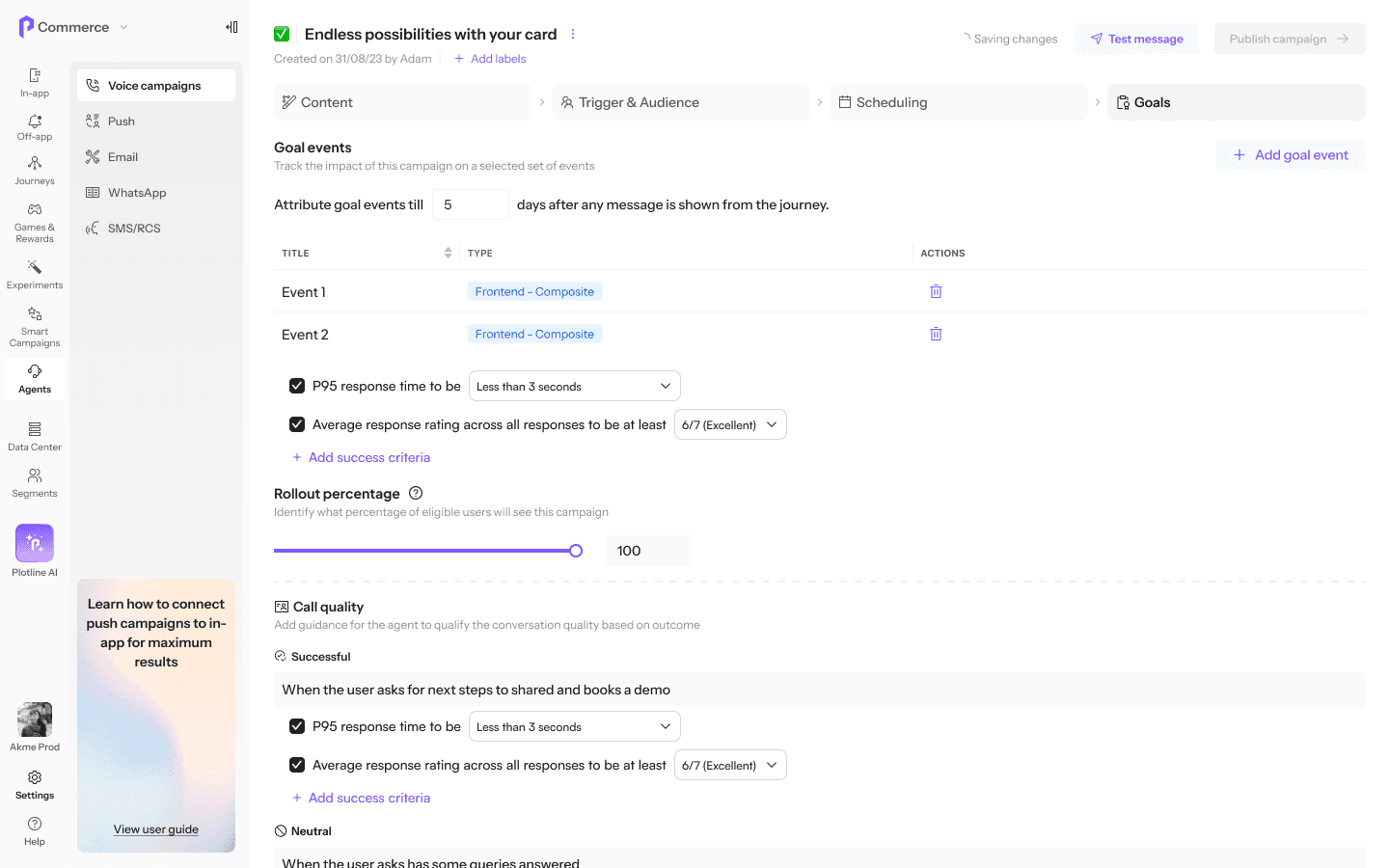
TESTING AND BUILDING TRUST IN YOUR AGENT
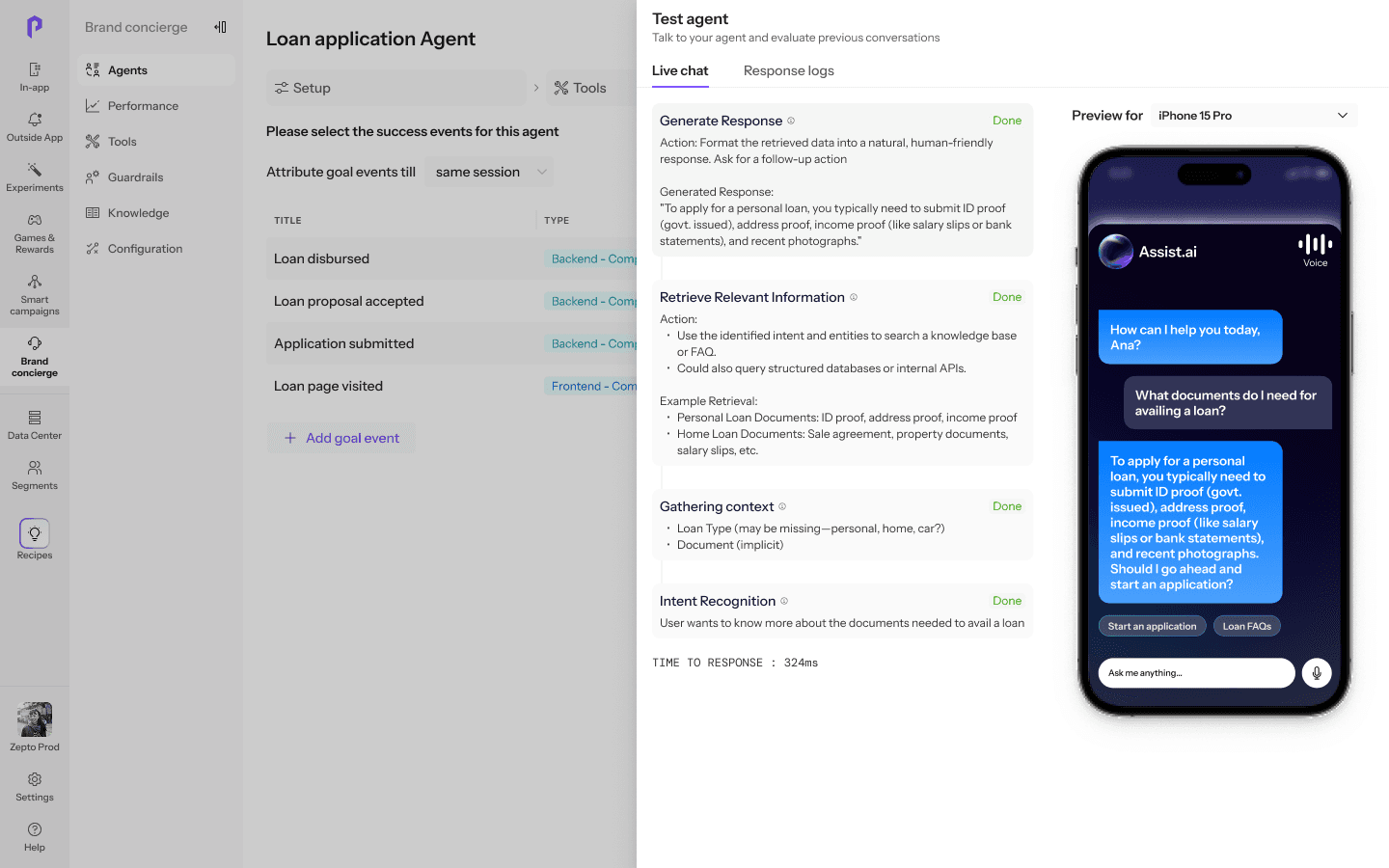
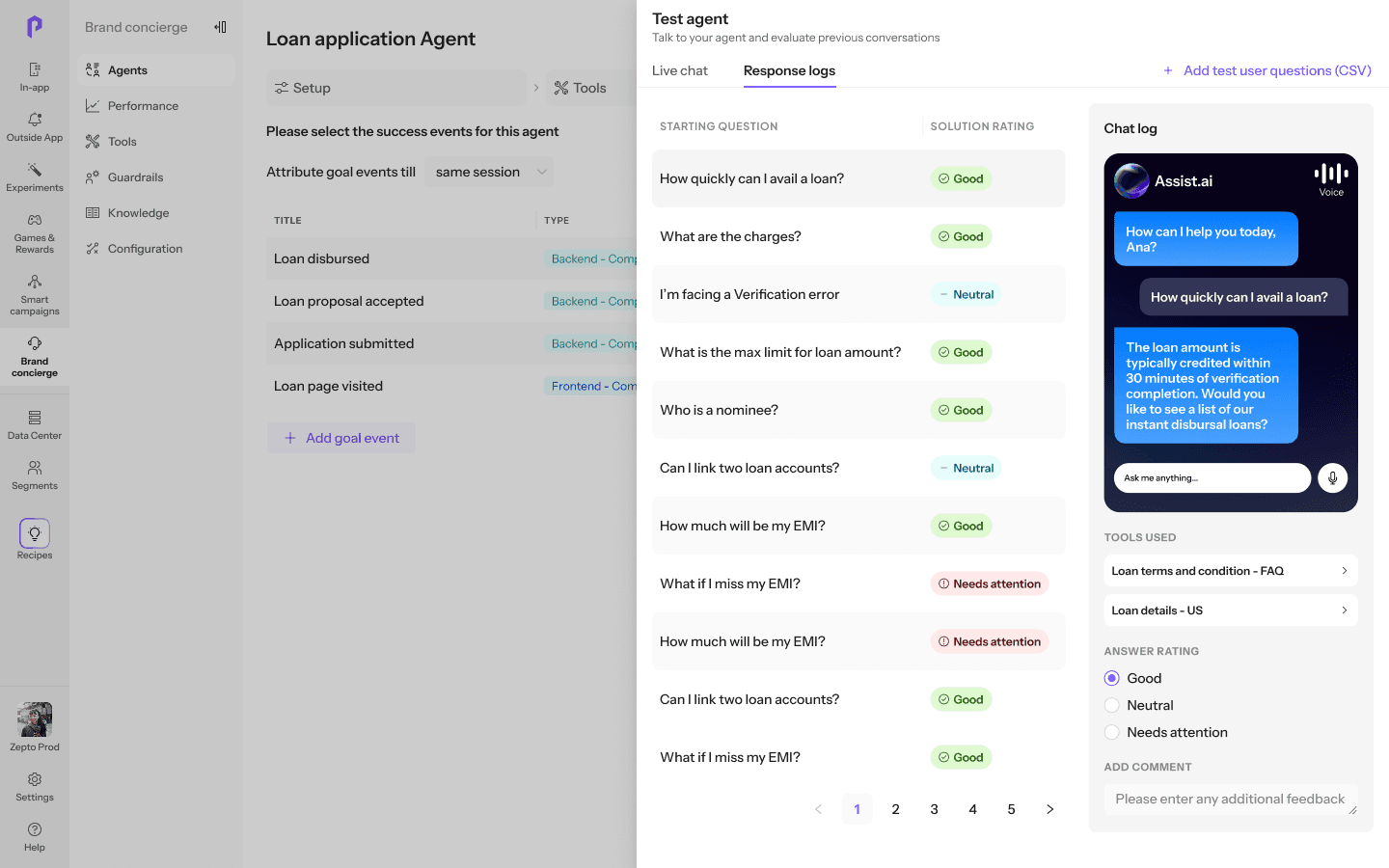
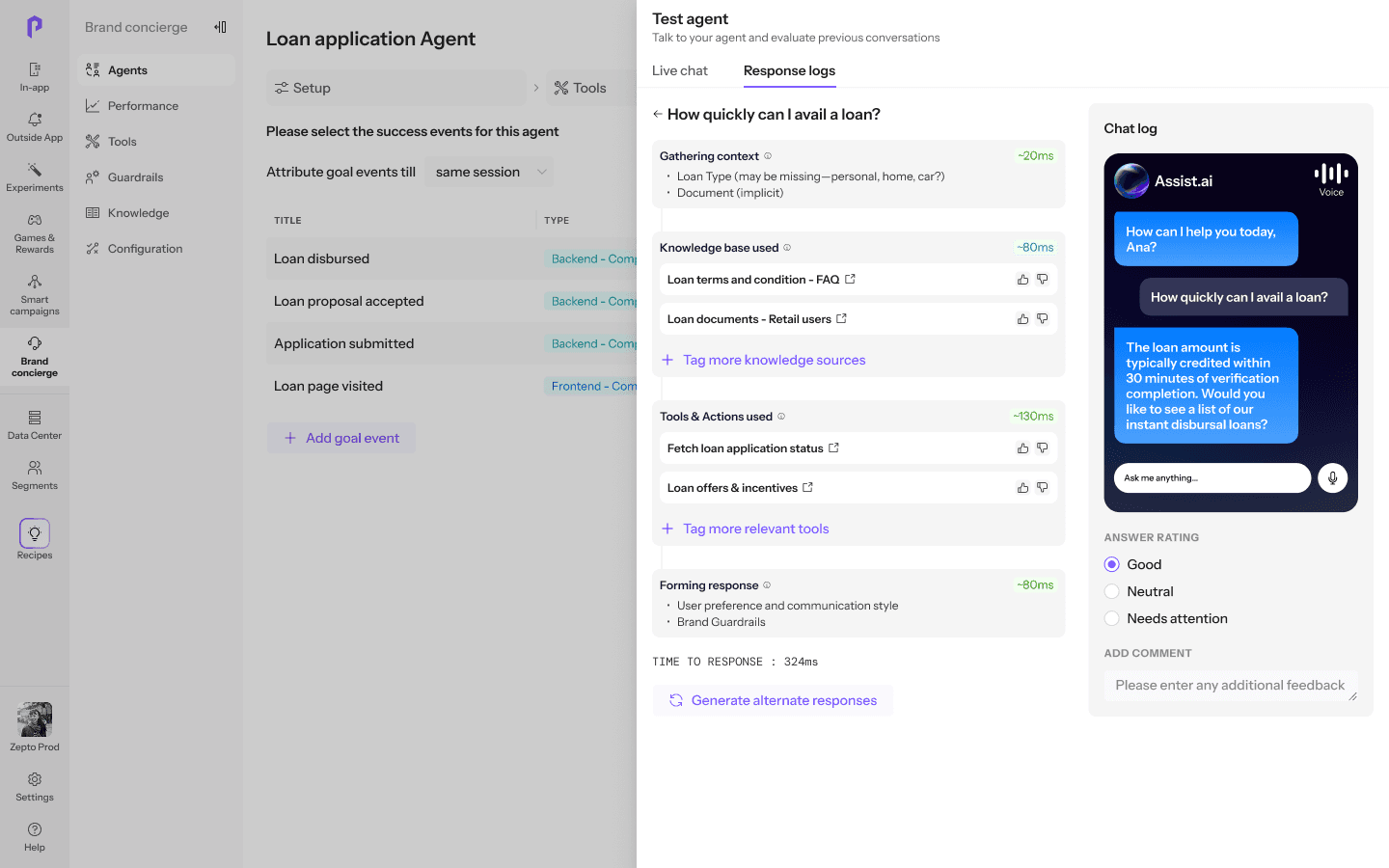
ENSURING THE AGENT SHOWS UP AND BEHAVES THE WAY WE WANT IT TO
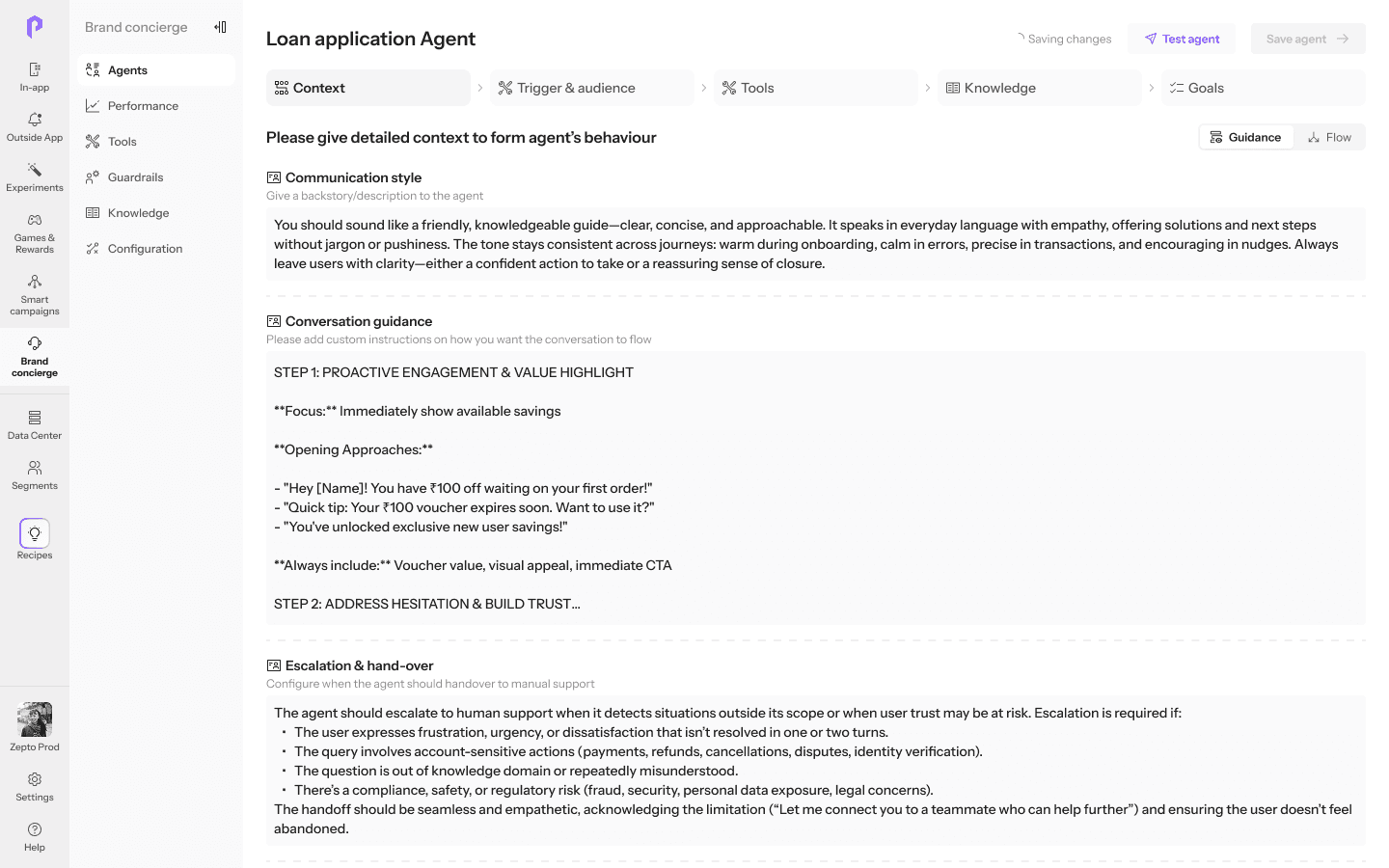
MAKING SENSE OF IT ALL

WHAT'S NEXT
Conceptualising how to build modular agentic experiences for platforms like Plotline, for marketers from leading consumer apps and visualising experience for their end users was a great opportunity to understand and design for:
Breaking the whole process into functions such as context, knowledge, tools & actions ensured a very gradual learning curve and progressive complexity.
Centralising appearance, communication and brand guidelines reduces the potential for inconsistent experiences
Building unbiased testing and learning flows for agent's training solves for trust at a scale of millions
Working on agentic experiences opens a whole world of possibilities. For the next versions, ideations and concepts have already started!
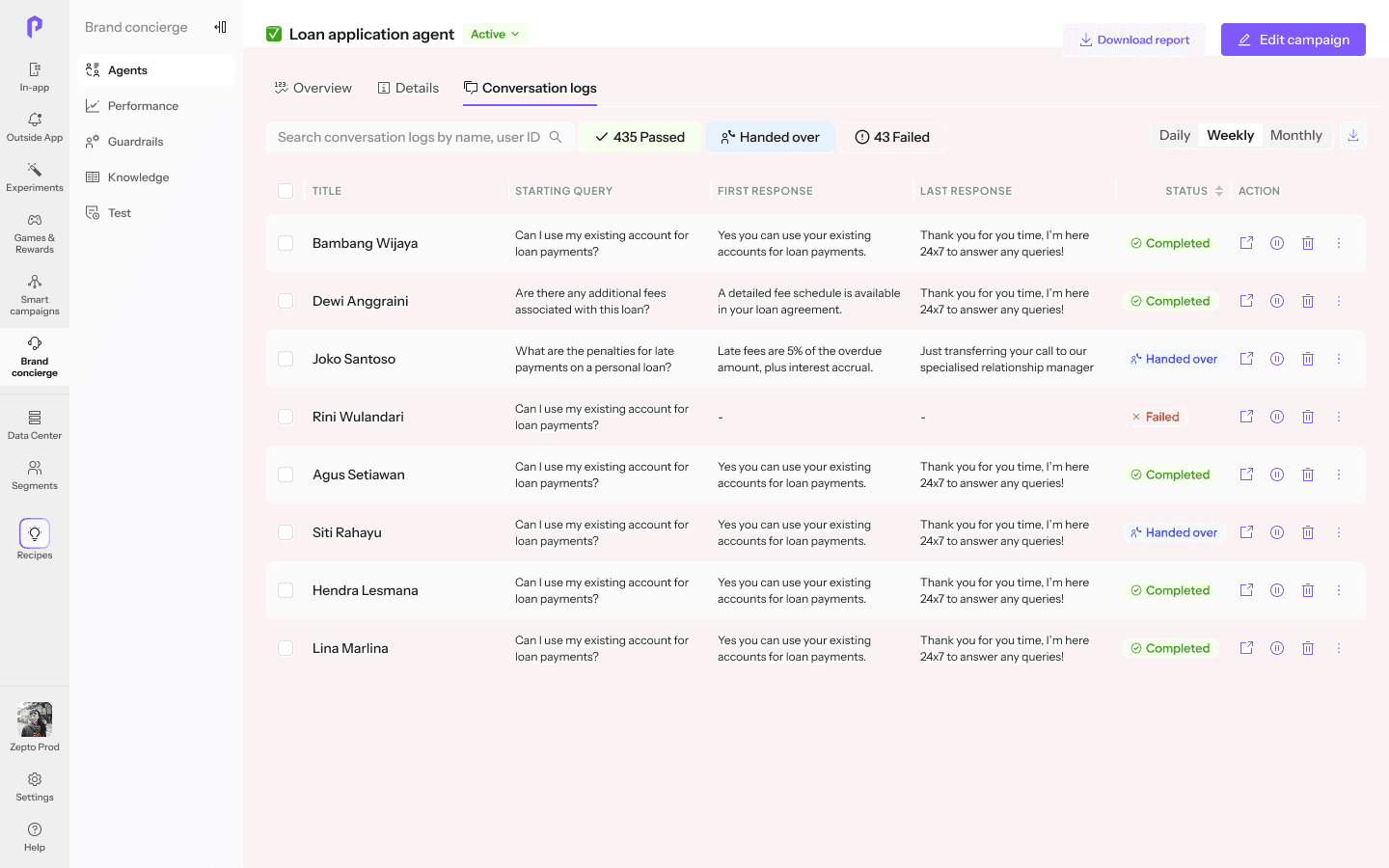
Real-time view into handoffs as they happen for live escalation visibility
Sessions with real users of pilot customers to close the gap we deliberately left open.
Access points like floating buttons, pinned banners, gestures like long hold, bottom swipe can be introduced

Plotline helps growth teams at consumer apps with onboarding, activation, adoption and retention use cases by letting them build elements like stories, in-line widgets, floating buttons, spotlights, quizzes, scratch cards and much more - without code. We have built a platform for marketers to enable them to nudge the right user at the right time to perform the intended action
PROBLEM
My objective is to enable marketers across industries and scale to engage their users the best way they can. A major part of this is to make comprehensive campaigns that help the operators with tasks such as segmentation, nudge design and making sure every campaign has that unique flavour for which their brand is known for.
Marketers wanted to know in general what was working for which use cases in their industry
They wanted to get inspired and then create and launch experiments at lightning speed
They felt they need to convince all the stakeholders multiple number of times and building inspired campaigns could help
There are many roles that the marketers have to play to decide - what to send, who to send to, when to send and what to optimize. Thus we felt that building a system that can assist them wherever they needed - be it building a complete campaign or just generating text options - will be something that'll add actual value to their daily processes.
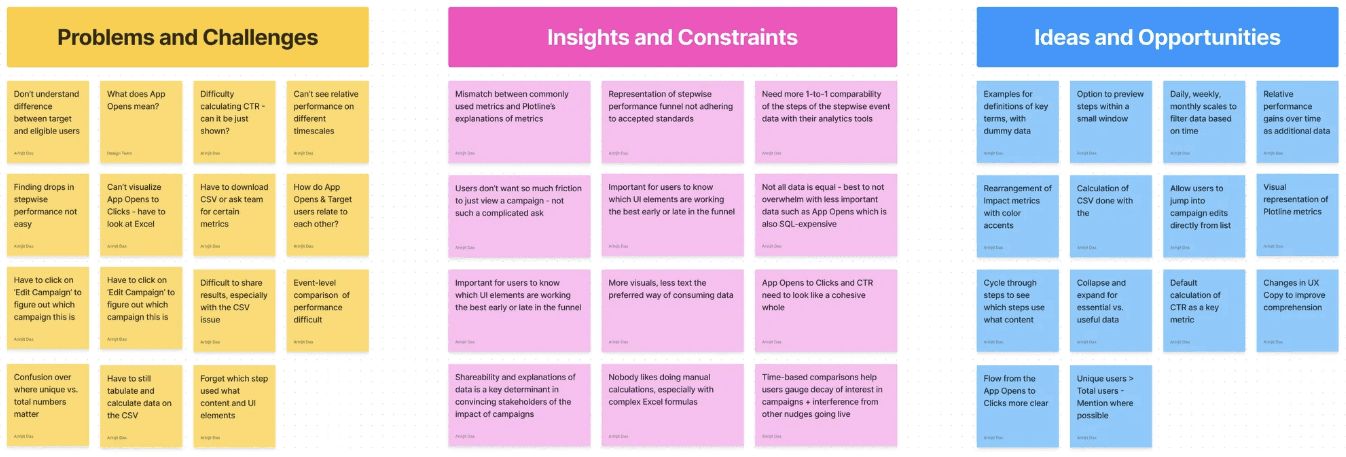
Understanding existing workflows, benchmarking, uncovering any latent aspirations
Marketers think about
What are they confident about
Their biggest frustrations
Their ideal experience
Build trust in our recommendations
Give quick and localised ideas wherever needed
Give comprehensive and global recommendations too

Ensuring every campaign recommendation is tailored to your brand
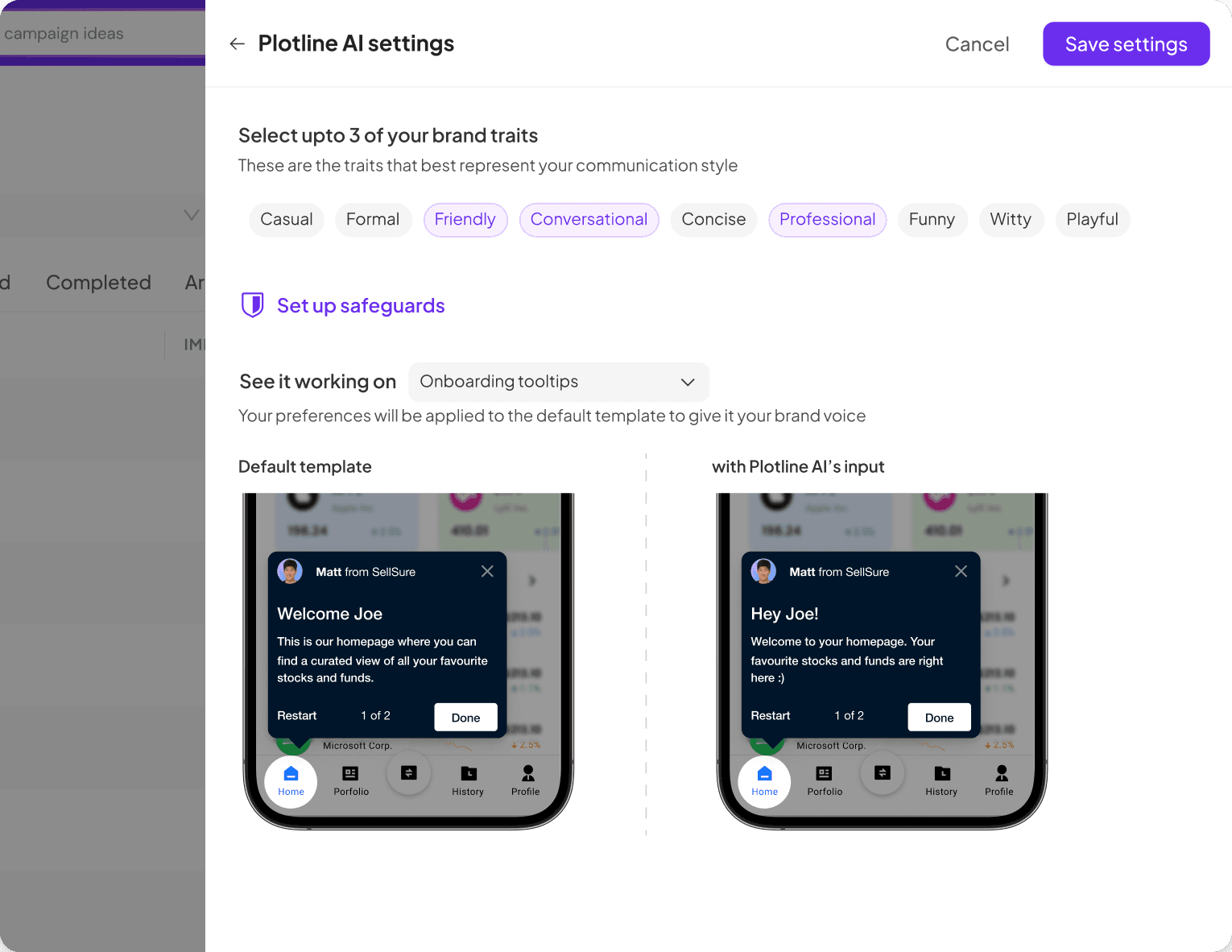
By developing a concept of 'Brand traits' all the recommendations are highly tailored to your unique brand voice, thus helping build trust with marketers.

Text specific recommendations
Scheduling recommendations
Generic inspiration - 'Recipes'
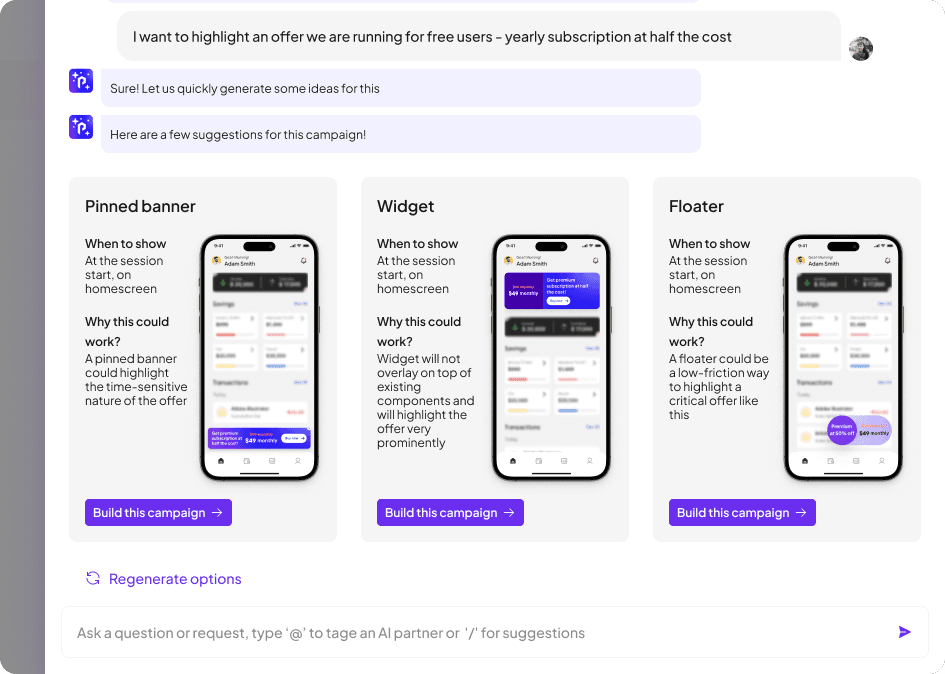
With 'Recipes (inspiration gallery)', marketers could launch 1 click campaigns with a majority of UI element selection, content and styling already taken care of!

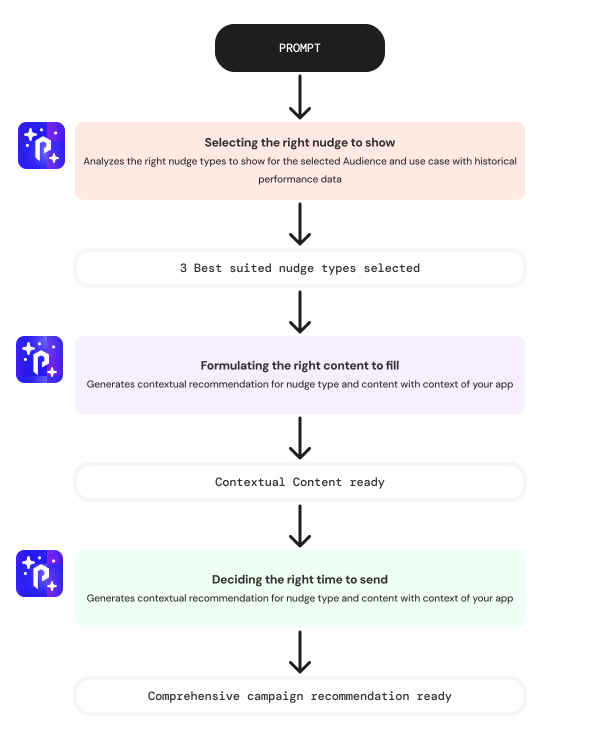
How it works
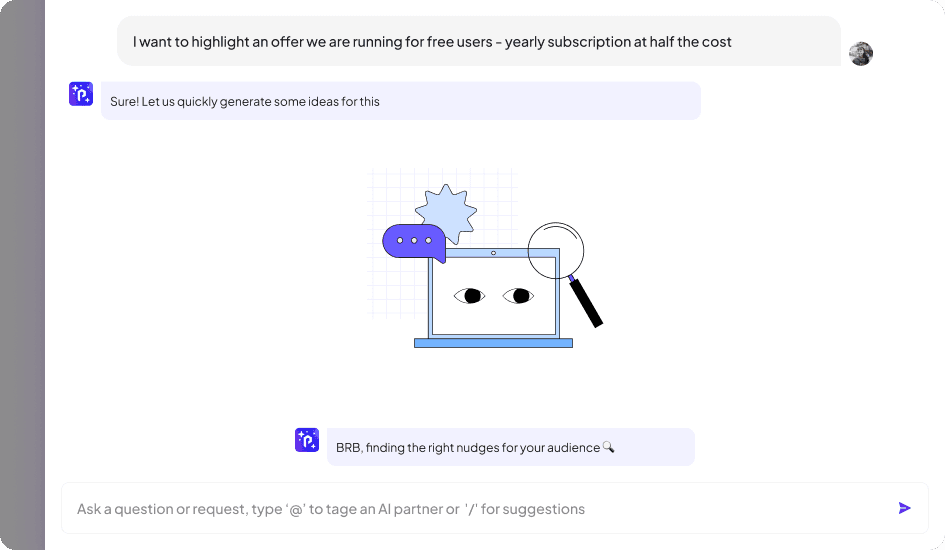
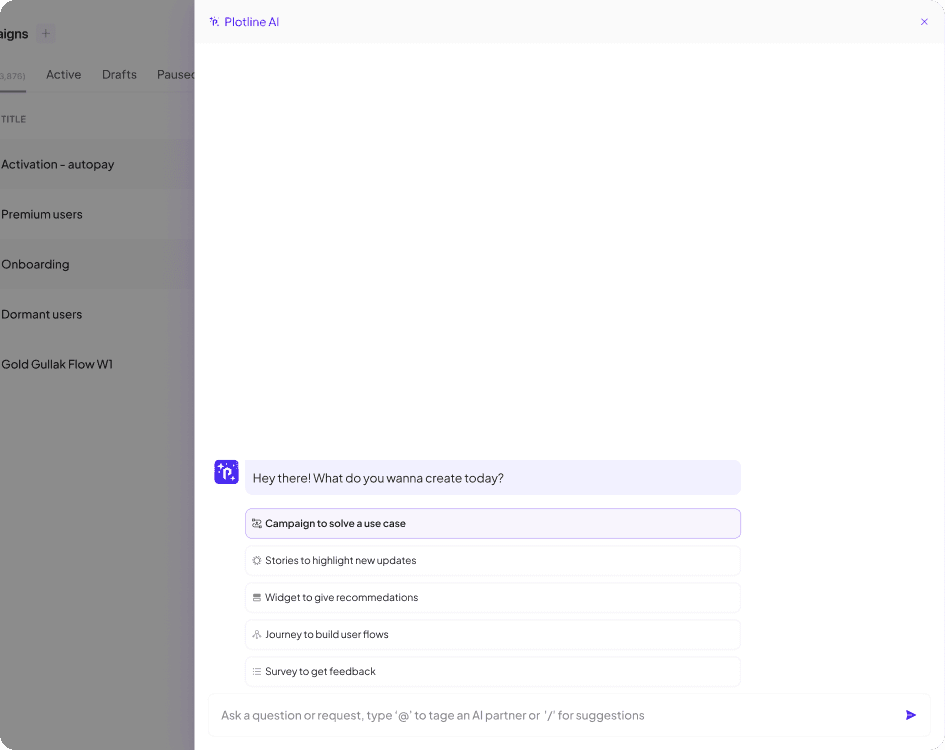
Step 1 - Some quick options like creating a campaign, a feedback survey or an instagram-like story are given to the user
Step 2 - Marketer shares the use case they want to solve
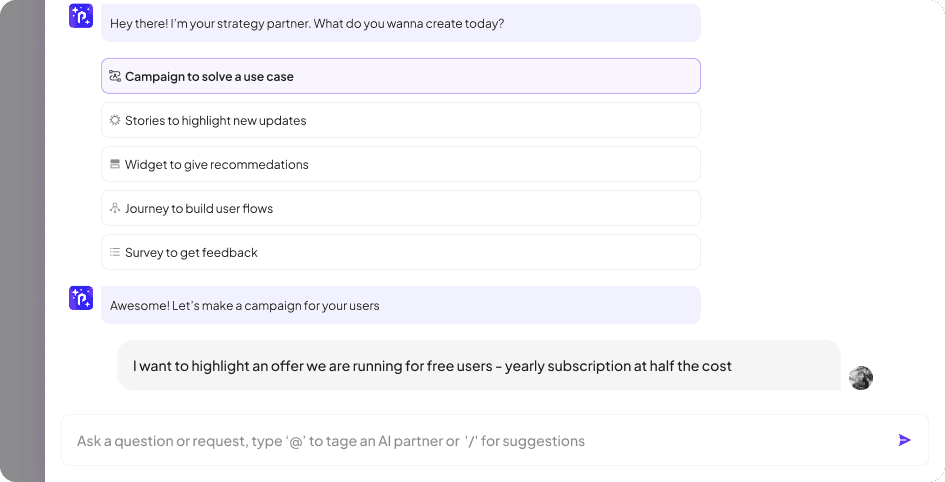
Step 3 - Ideas are generated based on the use case and channels that have worked for this group of users before